
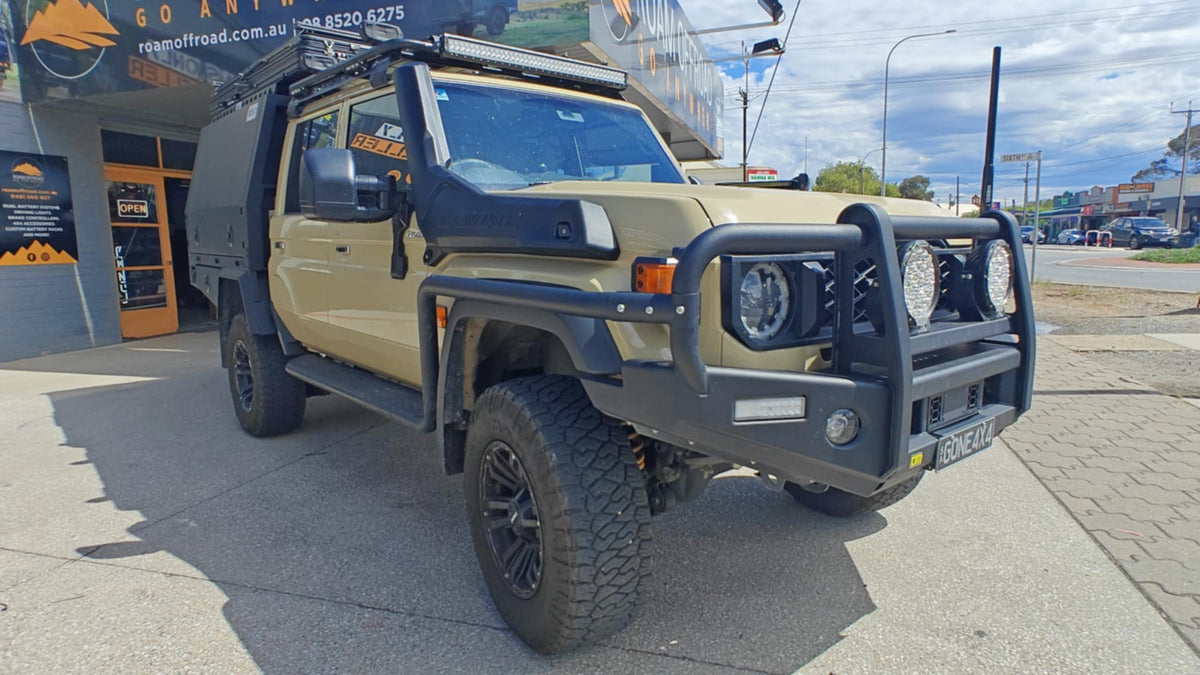
Short answer: a pre-rego GVM upgrade is fitted to a brand-new vehicle before its first registration under a Second Stage of Manufacture (SSM) approval, so the vehicle is registered at the higher GVM from day one. South Australia's Department for Infrastructure and Transport (DIT) says vehicles re-rated this way can be registered without needing DIT approval. A post-rego upgrade is done to a vehicle that is already registered, and in SA the re-rating has to be assessed and certified by a Light Vehicle Engineering Signatory (LVES) before the new GVM is recorded. Both are legal. Which one you can use mostly comes down to whether the vehicle has been registered yet.
What a GVM upgrade actually changes
GVM is the most your vehicle is allowed to weigh fully loaded (our guide to GVM, GCM, ATM and tow ball mass covers the terms). A GVM upgrade, also called a GVM re-rate or mass re-rating, raises that legal limit so a touring or work vehicle can carry its bull bar, canopy, drawers, water and gear without being overloaded.
DIT is clear that this is an engineering job, not just stiffer springs. Increasing GVM means accepting a different compromise from the one the vehicle maker chose, and upgrades may be needed to springs and dampers, tyres, and the cooling capacity of the engine and gearbox. That is why kits are engineered and tested for each model.
Pre-rego GVM upgrades
- Who it's for: new vehicles that have never been registered in SA or any other state.
- How it works: the upgrade is fitted under an SSM approval held by the kit's maker, and the vehicle carries an SSM plate. DIT says a vehicle re-rated this way may be registered without requiring DIT approval, and no action is needed from Vehicle Standards.
- Inspection: DIT says a roadworthiness inspection is not required for vehicles modified under pre-registration SSM.
- The catch: timing. It has to happen before the vehicle is first registered, so it needs organising between you, the dealer and the fitter before you pick the car up.
Post-rego GVM upgrades
- Who it's for: any vehicle already registered, including second-hand 4WDs and utes that have been accessorised over time.
- How it works: DIT requires approval to modify a light vehicle (GVM up to and including 4,500 kg), and a GVM increase on a registered vehicle needs careful analysis and testing by an SA Light Vehicle Engineering Signatory. Where the kit maker holds an SSM approval, the LVES may be able to use that company's engineering analysis and testing.
- Inspection: DIT says no roadworthiness inspection is needed for vehicles under 12 months old that are modified in line with an SSM approval by the SSM company and certified by an LVES. Outside that, check what applies to your vehicle; we'll go through it with you when we quote.
- Paperwork: DIT recommends a modification plate stating the revised rating, the VIN and enough detail to identify the modifier (not a heavy vehicle modification plate).
| Pre-rego | Post-rego | |
|---|---|---|
| Vehicle | New, never registered | Already registered (new or used) |
| Approval route | SSM approval, SSM plate fitted | Assessment and certification by an SA LVES |
| DIT approval | Not required to register (per DIT) | Approval to modify required |
| Roadworthiness inspection | Not required (per DIT) | Not required under 12 months old if SSM-compliant and LVES-certified; otherwise check |
| Best time to arrange | Before you collect the vehicle | Any time |

The limits to know
4,500 kg: the heavy vehicle line
If the upgraded GVM is more than 4,500 kg, the vehicle becomes a heavy vehicle. It must be registered and insured as a heavy vehicle, the driver needs a heavy vehicle licence, and modifications above that line come under the National Heavy Vehicle Regulator and the heavy vehicle code of practice, VSB 6.
3.5 tonnes and emissions
DIT notes that any vehicle manufactured on or after 1 November 2025 that has its GVM re-rated above 3.5 tonnes must comply with ADR 80/04 (emission control), which aligns with Euro VI. If you are buying new and planning a big upgrade, ask about this before you sign.
GCM and towing
A GVM increase does not automatically raise GCM, the maximum weight of the vehicle and trailer together. If GCM stays the same, every extra kilo you carry in the vehicle is a kilo you can't tow. Some kits also change braked towing capacity or GCM; others don't. Check the new ratings on the certification before you hitch up the van.
Where VSB 14 fits
VSB 14, the National Code of Practice for Light Vehicle Construction and Modification, sets out technical requirements for modifying light vehicles. It does not cover each state's administrative process, which is why the SA steps above come from DIT. Always check with DIT Vehicle Standards for the current process before any modification.
What's involved when we do it
Every GVM upgrade at our Gawler South workshop includes:
- a full vehicle assessment and weighing
- heavy-duty suspension (springs, shocks or coilovers) matched to the vehicle
- brake upgrades where the kit requires them
- engineering compliance certification
- the registration update with SA Transport
We fit GVM kits from Ironman 4x4, Tough Dog and Dobinsons, plus Offroad Industries (ORI) kits for American trucks, and regularly upgrade the Hilux, Prado, LandCruiser 70, 200 and 300 Series, Ranger, Everest, D-MAX, MU-X, Patrol, Navara and Triton. Kits are engineered per model, so if yours isn't listed, ask.
As with any modification, tell your insurer once the upgrade is done so it is noted on your policy.
Frequently asked questions
Can I get a GVM upgrade on a used or older 4WD?
Yes. That is a post-rego upgrade. In South Australia the re-rating of a registered vehicle has to be assessed and certified by a Light Vehicle Engineering Signatory (LVES), and the new GVM is recorded against the registration.
Is a pre-rego GVM upgrade better than post-rego?
Neither is better in itself. Pre-rego suits a brand-new vehicle that has not been registered yet, because it is registered at the higher GVM from day one under a Second Stage of Manufacture approval. Post-rego is the route for any vehicle already on the road.
Does a GVM upgrade increase towing capacity?
Not automatically. The SSM process can change GVM or braked towing capacity ratings, but a GVM increase on its own does not raise GCM. If GCM stays the same, extra weight carried in the vehicle can reduce what you can tow. Check the new ratings on your paperwork.
Do I need a heavy vehicle licence after a GVM upgrade?
Only if the upgraded GVM goes over 4,500 kg. Above that the vehicle becomes a heavy vehicle and must be registered and insured as one, and the driver needs a heavy vehicle licence.
Is a GVM upgrade legal in South Australia?
Yes, when it is done with an engineered kit and properly certified, with the new rating recorded by SA Transport. The certification is what makes it legal, not just the parts.
Thinking about a GVM upgrade?
Tell us what you drive, whether it's registered yet, and what you carry and tow. You'll get a firm quote before any work starts.
Get a QuoteCall 0481 569 90734 Adelaide Road, Gawler South SA 5118 · Mon to Fri 9am to 5pm, Sat 10am to 2pm
Sources
- Light vehicle mass re-rating, sa.gov.au (Department for Infrastructure and Transport)
- Apply to modify a light motor vehicle, sa.gov.au
- Vehicle Standards Bulletin 14 (VSB 14), Department of Infrastructure
- Vehicle Standards Bulletin 6 (heavy vehicle modifications), NHVR
General information only, current as at 5 October 2026. Requirements can change; check with DIT Vehicle Standards for your vehicle.