
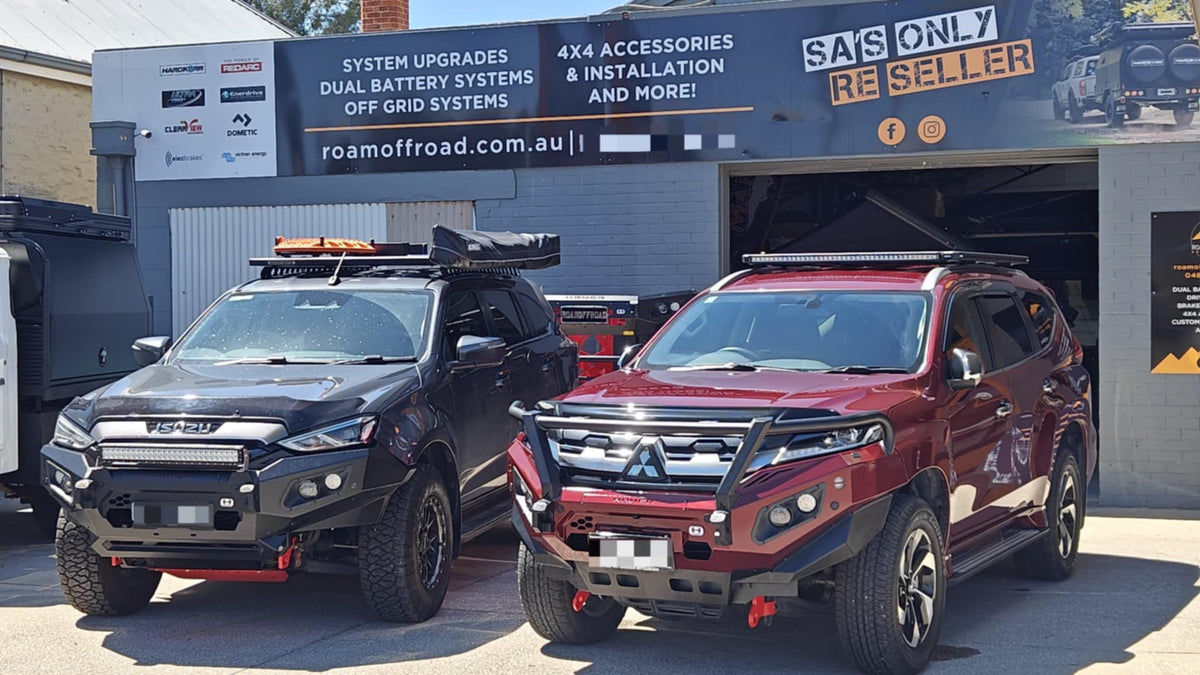
Short answer: in South Australia you can raise a 4WD by up to 50 mm in total, by suspension lift, body lift, bigger tyres or any combination, without a roadworthiness inspection. Go past 50 mm and you need prior approval, with a statement of requirements and a report from a Light Vehicle Engineering Signatory (LVES), plus a roadworthiness inspection. On a 4WD, tyres can be up to 50 mm larger in overall diameter than the largest size on the tyre placard. Bull bars on vehicles built from 1 July 2013 with a GVM up to 3.5 tonnes must comply with AS 4876.1-2002, follow the shape of the vehicle and not interfere with the airbags.
Here is what each rule means in practice, from the workshop that fits suspension, bull bars and wheel and tyre packages every week.
Lift kits and suspension: the 50 mm rule
DIT allows ride height to be raised by one method or a combination of three, up to 50 mm in total:
- Suspension lift: longer or higher-rated springs and matching shocks.
- Body lift: raising the body off the chassis.
- Tyres: fitting larger diameter tyres.
The key word is total. A 50 mm suspension kit uses the whole allowance on its own, so adding bigger tyres on top takes you over. When raising the suspension you must also keep the original amount of rebound travel, limited the same way the manufacturer did it (limit straps or the shock absorber's full extension).
Going higher than 50 mm
Anything over 50 mm in total needs prior approval in SA, with a statement of requirements and an LVES report, and a roadworthiness inspection. For context, the national code VSB 14 treats lifts of 50 mm to 150 mm as modifications that need certification, including a double lane-change stability test, says the front and rear must be raised by the same amount, and does not cover lifts over 150 mm at all. VSB 14 sets technical requirements only; SA runs its own approval process through DIT, so check with Vehicle Standards before you start.
Our suspension upgrades are matched to what you carry and how you drive, with alignment checks and a test drive. We fit Ironman 4x4, King Springs, Bilstein, FOX, Tough Dog and Airbag Man; see our Dobinsons and Tough Dog pages for those ranges.

Wheels and tyres
DIT's limit for 4WDs: the overall diameter of the wheel and tyre must not be more than 50 mm larger than the largest tyre size on the tyre placard, or more than 15 mm smaller than the smallest. For vehicles that aren't 4WDs, the upper limit is 15 mm.
Two other things to watch:
- Load rating: VSB 14 notes that where a vehicle's GVM is re-rated, tyre load capacity must be able to carry the revised GVM, in total and across each axle.
- Wheel track: VSB 14 limits off-road 4WDs and goods vehicles to no more than 50 mm of wheel track increase beyond the maximum the manufacturer specified for the model. Offset matters.
Our wheels and tyres team checks sizing, offset and clearance against your suspension and guards before anything is fitted.
Bull bars: what makes one legal in SA
DIT's requirements for bull bars (it calls them vehicle frontal protection systems) come down to five things:
- The standard. On vehicles built on or after 1 July 2013 with a GVM of no more than 3.5 tonnes, the bar must comply with the design and installation requirements of AS 4876.1-2002 (except clause 3.2) and must conform to the shape of the vehicle.
- Airbags. A vehicle with airbags, or built to ADR 69 or ADR 73, can only be fitted with a bar the vehicle maker has certified as suitable, or one the bar maker has shown does not affect ADR 69 or ADR 73 compliance or airbag timing. A poorly designed bar can make airbags fire at the wrong time.
- Front axle load. With the bar and accessories fitted, the loaded vehicle must not exceed the manufacturer's front axle load rating.
- Lights and visibility. The bar must not obscure the driver's view or any lights, including indicators. If it blocks lighting so the vehicle no longer meets ADR 13, additional ADR-compliant lamps must be fitted.
- No sharp bits. The bar must be free of sharp protrusions, and fittings such as driving light brackets, rod holders or aerial mounts must not protrude above the top or forward of the bar.
That is why we only fit vehicle-specific bars designed around ADR compliance and airbag compatibility, from ECB, PIAK, Hamer 4x4, Ironman 4x4, Offroad Animal, Raslarr, Rock Armor and Vikor. Parking sensors and cameras are relocated and kept working, and lights and wiring go in at the same booking. See bull bars and protection for steel vs alloy and the brands we stock.
Weight is the other half of the story. A steel bar plus a winch adds a lot over the front axle and eats into payload, so read our guide to GVM, GCM and payload before a big build.
Before you modify
- Add up every height change: kit, body lift and tyres together.
- Check the tyre placard and your vehicle's front axle and GVM ratings.
- For anything over 50 mm, talk to DIT Vehicle Standards and an LVES first; DIT says reviewing an application can take up to three weeks once it has all the information.
- Tell your insurer about every modification.
Frequently asked questions
Is a 2 inch lift legal in South Australia?
A 2 inch (50 mm) lift is within SA's limit, as long as the total increase in ride height from every source, including bigger tyres and any body lift, stays at or under 50 mm and the original rebound travel is kept.
Can I fit bigger tyres as well as a lift kit?
Only within the total. Bigger tyres raise the vehicle too, so a 50 mm kit plus larger tyres will usually take you past 50 mm in total. Past that point you need prior approval with an LVES report and a roadworthiness inspection.
How much bigger can tyres be on a 4WD in SA?
The overall diameter of the wheel and tyre can be up to 50 mm larger than the largest size on the tyre placard for a 4WD (15 mm for other vehicles), and no more than 15 mm smaller than the smallest placard size.
Are steel bull bars legal?
Yes. Steel and alloy bars are both legal when the bar is designed and fitted correctly. For vehicles built from 1 July 2013 with a GVM up to 3.5 tonnes, the bar must comply with AS 4876.1-2002 and follow the vehicle's shape, and it must not compromise the airbag system.
Do I need to tell my insurer about a lift kit or bull bar?
You should tell your insurer about any modification so it is noted on your policy, even when the modification itself is within the rules.
Planning a lift, tyres or a bull bar?
Tell us your vehicle and how you use it. We'll match a suspension, tyre and bar setup that suits the load and stays within the rules, and quote it before any work starts.
Get a QuoteCall 0481 569 90734 Adelaide Road, Gawler South SA 5118 · Mon to Fri 9am to 5pm, Sat 10am to 2pm
Sources
- Cars: vehicle standards and modifications, sa.gov.au
- Bull bars and frontal protection: design and construction, sa.gov.au
- Bull bar safety considerations, sa.gov.au
- VSB 14 Section LS: Tyres, Rims, Suspension and Steering (v2.1), Department of Infrastructure
- Apply to modify a light motor vehicle, sa.gov.au
General information only, current as at 5 October 2026. Rules can change; check the official sources above or DIT Vehicle Standards for your vehicle.